
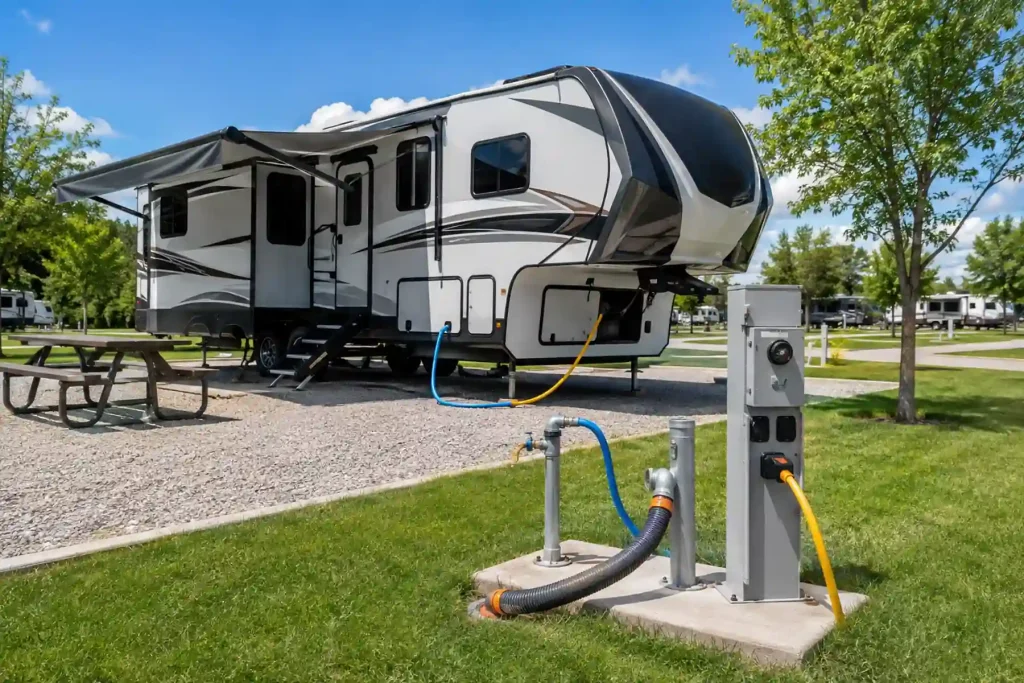
When you reserve an RV campsite, one of the first questions you may hear is, “Do you need 30 amp or 50 amp service?”
If you already know your RV well, the answer is easy. If you are new to RV camping, however, those numbers can be confusing.
What does 30 amp mean? Is 50 amp simply a little more powerful? Can a 30-amp RV plug into a 50-amp campsite? What happens if your campground only has one type of connection?
Understanding the difference between 30 amp vs. 50 amp RV hookups can help you choose the right campsite, avoid overloaded electrical systems, and make your campground stay more comfortable.
At Merritt Beach RV Park in Plattsmouth, Nebraska, RV sites offer 30- or 50-amp electrical options depending on the site. Knowing your RV’s electrical requirements before making a reservation helps campground staff match your rig with an appropriate available campsite.
Whether you own a small travel trailer, fifth wheel, Class A motorhome, or another type of RV, here is what you should know before connecting to campground power.
What Is an RV Electrical Hookup?
An RV electrical hookup allows you to connect your recreational vehicle to shore power at a campground.
Instead of relying entirely on batteries, solar panels, or a generator, you plug the RV into an electrical pedestal located at your campsite.
Once connected, shore power can supply electricity for equipment such as:
- Air Conditioners
- Refrigerators
- Microwave Ovens
- Televisions
- Electrical Outlets
- Battery Chargers
- Water Heaters
- Coffee Makers
- Hair Dryers
- Residential Appliances
The amount of electricity available depends largely on whether your RV uses a 30-amp or 50-amp connection.
That difference becomes especially important when running several high-demand appliances at the same time.
What Is a 30 Amp RV Hookup?
A 30-amp RV electrical system is common on smaller and mid-sized recreational vehicles.
A standard 30-amp RV connection supplies approximately 3,600 watts of usable power.
That is calculated using:
120 volts × 30 amps = 3,600 watts
A 30-amp RV plug typically has three prongs.
Those prongs serve as:
- One 120-Volt Hot Wire
- One Neutral Wire
- One Ground Wire
You may see the plug or campground receptacle identified as TT-30.
Many travel trailers, smaller fifth wheels, and Class C motorhomes use 30-amp electrical systems.
What Is a 50 Amp RV Hookup?
A 50-amp RV electrical system is generally found on larger RVs with greater electrical demands.
Unlike a 30-amp connection, a standard 50-amp RV service provides two separate 120-volt legs.
Each leg can provide up to 50 amps.
That means a 50-amp RV can theoretically access approximately:
120 volts × 50 amps × 2 = 12,000 watts
That is significantly more electrical capacity than a 30-amp RV connection.
A 50-amp RV plug normally has four prongs:
- Two Hot Wires
- One Neutral Wire
- One Ground Wire
Larger fifth wheels and Class A motorhomes commonly use 50-amp systems because they may contain:
- Two or Three Air Conditioners
- Residential Refrigerators
- Electric Fireplaces
- Washers and Dryers
- Multiple Televisions
- Larger Water Heaters
- More Electrical Outlets
- Additional Appliances
The greater electrical capacity allows more equipment to operate simultaneously without tripping the campground circuit breaker.
30 Amp vs. 50 Amp RV: The Biggest Difference
The biggest difference is available electrical capacity.
It is easy to assume that 50 amps provides only 20 amps more than 30 amps.
That is not actually how RV electrical systems work.
A typical 30-amp RV has approximately 3,600 watts available.
A properly connected 50-amp RV can have up to approximately 12,000 watts available across its two electrical legs.
That means a 50-amp RV service can provide more than three times the total electrical capacity of a 30-amp connection.
This extra capacity is why larger RVs can operate multiple air conditioners and other high-demand appliances at the same time.
Quick Comparison: 30 Amp vs. 50 Amp RV Hookups
| Feature | 30 Amp RV | 50 Amp RV |
| Typical Voltage | 120 Volts | Two 120-Volt Legs |
| Maximum Approximate Power | 3,600 Watts | 12,000 Watts |
| Plug Prongs | 3 | 4 |
| Common RV Types | Travel Trailers, Smaller Motorhomes | Large Fifth Wheels, Class A Motorhomes |
| Multiple AC Units | Limited | Better Equipped |
| Electrical Capacity | Moderate | High |
Your RV’s electrical system determines which connection it was designed to use.
How Do I Know Whether My RV Is 30 Amp or 50 Amp?
The easiest method is to look at your RV’s shore-power plug.
A 30-Amp RV Plug
Usually has:
- Three Prongs
- A Smaller Plug Head
- One Angled Hot Blade
- One Neutral Blade
- One Ground Pin
A 50-Amp RV Plug
Usually has:
- Four Prongs
- A Larger Plug Head
- Two Hot Blades
- One Neutral Blade
- One Ground Pin
You can also check:
- Your RV Owner’s Manual
- The Electrical Panel
- Labels Near the Power Connection
- Manufacturer Specifications
Do not guess.
Knowing your electrical requirement before contacting a campground makes the reservation process easier.
Why Does Electrical Capacity Matter at a Campground?
Your RV may contain several appliances that use large amounts of electricity.
Air conditioners are among the most significant electrical loads in many RVs.
Other high-demand appliances can include:
- Microwave Ovens
- Electric Water Heaters
- Space Heaters
- Hair Dryers
- Coffee Makers
- Toasters
- Electric Skillets
On a 30-amp system, running several of these appliances simultaneously can exceed available power.
For example, suppose your air conditioner is running while someone uses the microwave and another person turns on a hair dryer.
The combined electrical demand may cause the breaker to trip.
That does not necessarily mean something is wrong with your RV or campground connection.
It may simply mean you attempted to use more electricity than the 30-amp system could provide.
Managing Power in a 30 Amp RV
People camp comfortably in 30-amp RVs every day.
The key is managing electrical usage.
If you have a 30-amp system, pay attention to which high-demand appliances are operating at the same time.
For example, you may want to avoid simultaneously running:
- Air Conditioning
- Microwave
- Hair Dryer
- Electric Water Heater
- Portable Space Heater
Instead, temporarily turn one appliance off before using another.
With a little power management, a 30-amp connection can easily support normal RV camping.
Why Larger RVs Often Need 50 Amp Service
Large modern RVs can contain many of the same appliances found in a house.
A large fifth wheel or motorhome may have:
- Multiple Air Conditioners
- Residential Refrigerator
- Dishwasher
- Washer and Dryer
- Electric Fireplace
- Induction Cooktop
- Entertainment Systems
- Multiple Charging Devices
Trying to operate all of this equipment from a 30-amp connection would require constant power management.
A 50-amp electrical system gives larger RVs much more capacity.
That is why it is important to tell the campground you need 50-amp service when making your reservation.
Can a 30 Amp RV Plug Into a 50 Amp Campsite?
Generally, yes.
A 30-amp RV can typically connect to a 50-amp campground outlet using an appropriate 50-to-30-amp RV adapter, often called a dogbone adapter.
The adapter allows your 30-amp RV cord to connect to the campground’s 50-amp receptacle.
However, using the adapter does not turn your 30-amp RV into a 50-amp RV.
Your RV’s electrical system is still designed for approximately 30 amps.
You will not suddenly have enough capacity to run significantly more appliances.
Use an RV-rated adapter designed specifically for the connection you are making.
Can a 50 Amp RV Plug Into a 30 Amp Campsite?
A 50-amp RV can generally connect to a 30-amp campground receptacle using the proper adapter.
But there is an important limitation.
Your RV will only have access to the electrical capacity available from the 30-amp connection.
That means you cannot use your RV as though it were connected to full 50-amp service.
You may need to limit:
- Number of Air Conditioners Running
- Microwave Use
- Electric Water Heating
- Washer or Dryer Use
- Space Heaters
- Other Large Appliances
If you exceed the available electrical capacity, the 30-amp campground breaker may trip.
For this reason, 50-amp RV owners should request a true 50-amp site whenever possible.
An Adapter Does Not Create More Power
This is one of the most important things to understand about RV electrical adapters.
An adapter changes the physical connection.
It does not magically increase available campground electricity.
If a 50-amp RV is connected to a 30-amp pedestal, the electrical supply is still limited by the campground’s 30-amp circuit.
Likewise, plugging a 30-amp RV into a 50-amp pedestal does not convert the RV’s internal system to 50 amp.
Think of the adapter as a way to make compatible connections when necessary, not as an electrical upgrade.
Should You Carry RV Electrical Adapters?
Many experienced RV travelers carry common electrical adapters because campground configurations can vary.
Useful equipment may include:
- 50-to-30-Amp Adapter
- 30-to-50-Amp Adapter
- RV Surge Protector
- Electrical Management System
- Proper RV Extension Cord When Appropriate
However, never use homemade adapters or force incompatible electrical connections.
Equipment should be designed and rated for RV electrical service.
If you are unsure whether an adapter is appropriate, consult your RV manufacturer’s recommendations or a qualified RV technician.
Why a Surge Protector Is Worth Considering
Campground electricity can vary from location to location.
An RV surge protector or electrical management system may help protect your RV’s electrical equipment from certain power problems.
Depending on the device, protection may include monitoring for:
- High Voltage
- Low Voltage
- Power Surges
- Open Ground
- Reverse Polarity
- Wiring Problems
Modern RVs can contain expensive electronics, appliances, air-conditioning equipment, and control boards.
Electrical protection can provide additional peace of mind, particularly for travelers who frequently stay at different campgrounds.
Never Force an RV Electrical Plug
If the plug does not fit the campground receptacle, stop.
Do not bend prongs, modify cords, or attempt to force the connection.
A 30-amp plug and 50-amp plug are intentionally designed differently.
Use only the proper RV adapter if one is required.
You should also inspect your power cord before connecting.
Look for:
- Damaged Insulation
- Bent Prongs
- Burn Marks
- Corrosion
- Melted Plastic
- Loose Connections
Damaged electrical equipment should be repaired or replaced before use.
Check the Breaker Before Connecting
Many RV owners prefer to switch the campground pedestal breaker off before plugging in the RV.
Once the connection is secure, the breaker can be switched on.
When disconnecting, reverse the process:
- Turn Off the Pedestal Breaker
- Disconnect the RV Cord
- Secure the Cord for Travel
Following a consistent connection routine helps reduce unnecessary electrical arcing at the plug.
Always follow your RV manufacturer’s recommended electrical procedures.
Summer Camping Makes Electrical Service Especially Important
Electrical capacity becomes particularly noticeable during hot weather.
Nebraska summers can bring warm temperatures when RV air conditioning is important for comfort.
An RV with multiple air-conditioning units may require 50-amp service to operate them as intended.
A smaller trailer with one air conditioner may operate comfortably on 30 amps, although other high-demand appliances may still need to be managed.
Before arriving during summer, confirm:
- Your RV’s Electrical Requirement
- Number of Air Conditioners
- Campground Service Availability
- Condition of Your Power Cord
- Whether You Need an Adapter
- Whether You Have Electrical Protection Equipment
It is much easier to solve these issues before beginning your trip.
What Electrical Hookups Does Merritt Beach RV Park Offer?
Merritt Beach RV Park offers RV sites with 30- or 50-amp electrical service, depending on the site and availability.
The campground also provides water hookups at RV sites.
Merritt Beach accommodates different types of stays, including:
- Overnight RV Stays
- Weekly RV Stays
- Monthly RV Sites
- Seasonal RV Camping
Because electrical requirements vary by RV, guests should provide their rig information when requesting a reservation.
Information to Provide When Booking Your RV Site
Do not simply tell the campground that you have “a camper.”
The more information you provide, the easier it is to identify a suitable available site.
Have the following details ready:
RV Type
Tell the campground whether you have a:
- Travel Trailer
- Fifth Wheel
- Class A Motorhome
- Class B Motorhome
- Class C Motorhome
- Toy Hauler
- Other RV Type
RV Length
Know the total length of your RV.
This is particularly important for larger fifth wheels and motorhomes.
Electrical Requirement
Clearly state whether you need:
30 amp or 50 amp.
If your RV requires full 50-amp service to operate multiple appliances comfortably, mention that when requesting availability.
Number of Guests
Occupancy can affect campsite arrangements and campground policies.
Pets
If traveling with pets, confirm the campground’s current pet requirements before arrival.
Dates
Provide your exact arrival and departure dates.
Electrical-site availability can vary throughout the camping season.
Do Not Assume Every Campsite Has Both Connections
Some campgrounds have electrical pedestals offering multiple receptacles.
Others have sites designated primarily for one type of service.
Availability can also depend on the particular campsite.
That is why it is important to confirm your requirement during the reservation process.
Do not arrive with a 50-amp RV expecting every available campsite to offer full 50-amp electrical capacity.
The same is true when relying on adapters.
Planning ahead gives the campground a better opportunity to match your RV with an appropriate site.
30 Amp vs. 50 Amp Does Not Determine Campsite Quality
A 50-amp campsite is not automatically “better” than a 30-amp campsite.
It simply provides a different level of electrical capacity.
If your RV was designed for 30-amp service, that may be all the power you need.
Choosing the correct electrical connection is about matching the campsite to your equipment.
Other factors can be equally important when selecting an RV site, including:
- Site Size
- Water Connection
- Location Within the Campground
- RV Accessibility
- Recreation
- Length of Stay
- Campground Rules
- Proximity to Local Services
Electrical service is only one part of choosing the right campground.
Know Your RV Before Your Next Camping Trip
Understanding the difference between 30 amp and 50 amp RV hookups does not require becoming an electrician.
For most campers, the essentials are simple:
Know what electrical service your RV requires.
Understand that 50 amp provides significantly more available power than 30 amp.
Use only proper RV electrical equipment and adapters.
Do not expect an adapter to increase the actual power available.
Tell the campground your electrical requirements before booking.
These few steps can prevent a lot of confusion when you arrive.
Plan Your RV Stay at Merritt Beach
Whether you are stopping for one night, spending a week near Omaha, or settling in for an extended RV stay, having the correct electrical connection helps make your campsite more comfortable.
Merritt Beach RV Park in Plattsmouth offers RV sites with water hookups and 30- or 50-amp electrical options, depending on site availability.
The campground also gives guests access to its swimming lake, stocked fishing lake, playground, volleyball area, and outdoor recreation while remaining within driving distance of Plattsmouth, Bellevue, and Omaha.
Before reserving, check your RV plug or owner’s manual so you know whether your rig requires 30-amp or 50-amp service.
Then provide that information along with your RV type, length, travel dates, and other requirements when requesting a site.
Call Merritt Beach RV Park at 402-979-1196 or request site availability online to confirm your dates, RV size, electrical requirements, current rates, and available campsite options.