
Seeing that an RV campground does not have sewer connections at every campsite can raise an immediate question:
How do you camp comfortably without a sewer hookup?
For experienced RV travelers, the answer is straightforward. Recreational vehicles are designed with holding tanks that allow campers to use sinks, showers, and toilets even when they are not continuously connected to a sewer system.
For newer RV owners, however, the idea of managing black and gray water can feel intimidating.
The good news is that RV camping without sewer hookup is manageable once you understand how your tanks work, how quickly they fill, and what options are available for emptying them.
At Merritt Beach RV Park in Plattsmouth, Nebraska, RV sites include water and electrical hookups, while individual sites do not have sewer connections. Guests who need their holding tanks emptied can arrange pump-out service through local providers for an additional fee.
Whether you are staying overnight, for a week, or longer, a little planning can make camping without a direct sewer connection simple and comfortable.
What Does “No Sewer Hookup” Mean at an RV Campground?
RV campgrounds can offer several different levels of hookups.
A campsite may provide:
- Electric Only
- Water and Electric
- Water, Electric, and Sewer
- No Utility Hookups
When a campsite offers water and electricity but no sewer connection, you can connect your RV to campground water and shore power, but your wastewater remains inside the RV’s holding tanks until it is emptied.
This is different from a full-hookup site, where a sewer hose can remain connected to a sewer inlet at the campsite.
Camping without individual sewer hookups means you need to monitor your tanks and plan when they will be emptied.
For a short stay, you may not need to empty them at all.
For weekly or extended stays, you may need pump-out service or another approved method of emptying your tanks.
Understanding Your RV Holding Tanks
Most modern RVs have three basic water systems:
- Fresh Water
- Gray Water
- Black Water
Understanding the purpose of each system is the foundation of camping without a sewer hookup.
What Is an RV Freshwater Tank?
Your freshwater tank stores clean water for use inside the RV when you are not connected directly to campground water.
Fresh water may be used for:
- Drinking, when the system is maintained for potable use
- Washing Hands
- Showering
- Flushing the Toilet
- Washing Dishes
- Cooking
At campgrounds with a water connection at the site, you may be able to connect a potable-water hose directly to the RV rather than relying entirely on your onboard freshwater tank.
Merritt Beach RV Park provides water hookups at its RV sites, which means guests can have convenient access to water during their stay.
However, having unlimited access to fresh water does not mean your wastewater tanks have unlimited capacity.
Every gallon that goes down a sink or shower drain eventually has to go somewhere.
That is why water conservation remains important when camping without sewer hookups.
What Is an RV Gray Water Tank?
The gray water tank generally collects wastewater from areas such as:
- Kitchen Sinks
- Bathroom Sinks
- Showers
In many RVs, the gray tank fills faster than the black tank.
This often happens because people use more water for showers, handwashing, dishes, and cooking than they realize.
A long shower may use several gallons of water. Washing dishes under continuously running water adds even more.
During a week-long campground stay, gray-water management may become your biggest concern.
What Is an RV Black Water Tank?
The black water tank generally holds waste from the RV toilet.
This tank requires careful handling and proper sanitation practices.
How quickly a black tank fills depends on factors such as:
- Tank Capacity
- Number of Campers
- Toilet Usage
- Amount of Water Used Per Flush
- Length of Stay
A couple staying in a large RV may be able to go several days or longer without needing service.
A family using a smaller RV may need to empty the tank sooner.
Every RV is different, so knowing your tank capacities before an extended stay is important.
How Long Can You Camp Without a Sewer Hookup?
There is no single answer.
One RV might comfortably go a week without needing its tanks emptied, while another may need service after only a few days.
The biggest factors are:
Tank Size
RV holding tanks vary considerably in capacity.
Larger motorhomes and fifth wheels may have larger tanks than compact travel trailers.
Check your owner’s manual or manufacturer specifications so you know what your RV can hold.
Number of People
Two people generally produce less wastewater than a family of five.
The more campers using the toilet, sinks, and shower, the faster tanks fill.
Shower Habits
Long showers can fill a gray tank surprisingly quickly.
If you are trying to extend the time between pump-outs, reducing shower water usage can make a major difference.
Dishwashing
Leaving water running while washing dishes wastes tank capacity.
Using a basin or filling the sink partially can significantly reduce wastewater.
Length of Stay
An overnight guest may never need tank service.
A weekly camper should pay closer attention.
Monthly campers should expect to establish a regular tank-management routine.
How Do You Know When an RV Holding Tank Is Full?
Most RVs have a tank monitoring system that displays approximate levels.
You may see indicators such as:
- Empty
- One-Third
- Two-Thirds
- Full
Some systems provide percentage estimates.
However, RV tank sensors are not always perfectly accurate. Residue inside the tank can sometimes cause incorrect readings.
Experienced RV owners often combine the monitor reading with their knowledge of normal water usage.
Signs that a tank may be approaching capacity can include:
- Slow Drainage
- Water Backing Up
- Unusual Tank Readings
- Toilet Changes
- Gurgling From Drains
Ideally, you should arrange service before the tank becomes completely full.
Waiting until wastewater backs up into the RV creates an unnecessary mess.
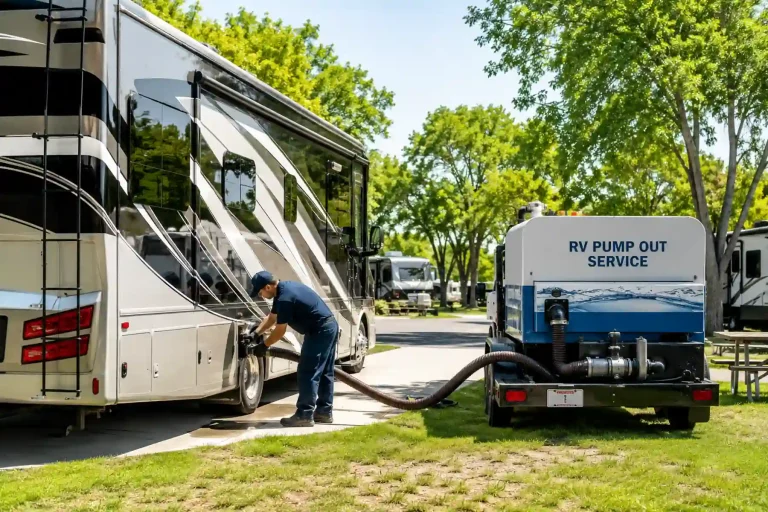
What Is RV Pump-Out Service?
A pump-out service empties wastewater from your RV’s holding tanks without requiring you to move the RV to another location.
A service provider brings specialized equipment to the campsite, connects to your RV’s waste outlet, and removes the contents of the tanks for proper disposal.
This can be particularly convenient for:
- Weekly Campers
- Monthly Campers
- Larger RVs
- Campers Who Do Not Want to Move Their Rig
- Guests Staying in One Site for an Extended Period
At Merritt Beach RV Park, local pump-out providers can service RV holding tanks for an additional fee.
Guests planning an extended stay should ask about the current process when making their reservation.
Why Pump-Out Service Can Be Convenient for Longer Stays
Moving a fully set-up RV just to empty the tanks can be inconvenient.
Imagine you have already:
- Leveled the RV
- Connected Power
- Connected Water
- Extended Slides
- Positioned Outdoor Furniture
- Set Up Stabilizers
- Organized Your Campsite
If tank service can come directly to your RV, you avoid having to disconnect everything and reposition the rig.
For people staying a week or a month, that convenience can make camping without a sewer hookup much easier.
How Often Will You Need Pump-Out Service?
The frequency depends entirely on your RV and how you use it.
A solo traveler may need service much less frequently than a family.
Instead of relying on a fixed schedule, monitor your actual tank levels.
Consider keeping track of how long your tanks last during your first several days.
For example:
Day 1: Tanks emptied before arrival.
Day 3: Gray tank approximately half full.
Day 5: Gray tank nearing capacity.
Once you understand your normal usage, planning future pump-outs becomes much easier.
How to Make Your Gray Tank Last Longer
Gray tanks are often the first limitation during camping without sewer hookups.
A few changes can greatly extend their capacity.
Take Shorter Showers
An RV shower does not need to run continuously.
One common method is to:
- Wet Down
- Turn the Water Off
- Soap and Shampoo
- Turn the Water Back On to Rinse
This dramatically reduces the amount of water entering the gray tank.
Do Not Leave Faucets Running
Turn off the faucet while:
- Brushing Teeth
- Shaving
- Scrubbing Dishes
- Washing Produce
Small amounts of saved water add up over several days.
Wash Dishes Efficiently
Instead of letting water run continuously, fill the sink or a small basin with the amount you need.
Wipe excess food from plates before washing so less water is needed.
Use Campground Facilities When Available
When appropriate facilities are provided, using them can reduce water use inside your RV.
Always follow campground rules regarding where water and wastewater may be disposed of.
How to Make Your Black Tank Last Longer
Black tanks usually fill more slowly than gray tanks, but they still require proper management.
Use Enough Water When Flushing
It may sound counterintuitive, but trying to conserve too much water in the black tank can create problems.
Black tanks need enough liquid to help waste move properly when the tank is emptied.
Use RV-Compatible Toilet Paper
RV-friendly toilet paper is designed to break down more easily in holding tanks.
Some standard toilet papers may also be appropriate if they dissolve quickly, but check your RV manufacturer’s guidance.
Never Put Non-RV Waste Down the Toilet
Avoid flushing items such as:
- Baby Wipes
- Paper Towels
- Feminine Hygiene Products
- Diapers
- Household Cleaning Wipes
- Grease
- Food Waste
Even products marketed as flushable may cause problems in an RV holding tank.
Should You Leave Your Black Tank Valve Open?
If you ever stay at a full-hookup campground, you may be tempted to leave the sewer valve open continuously.
For black tanks, this is generally not the preferred method.
Allowing liquid to drain constantly while solid waste remains behind can create buildup inside the tank.
Instead, black tanks are typically allowed to fill to an appropriate level before being emptied.
This allows the liquid inside the tank to help carry waste through the sewer hose during dumping.
When staying without a sewer hookup, this naturally happens because the tank remains closed until pump-out service is performed.
Can You Dump Gray Water on the Ground?
Do not assume that gray water can be released onto the ground.
Rules regarding wastewater disposal vary by campground and jurisdiction.
Even though gray water does not contain toilet waste, it can contain:
- Food Particles
- Soap
- Oils
- Cleaning Products
- Bacteria
- Personal Care Products
Only empty gray and black tanks using methods permitted by the campground and applicable local regulations.
At Merritt Beach, guests should follow campground procedures and use approved pump-out services when tank emptying is required.
Never Open a Waste Valve Without a Proper Connection
This should be obvious, but it is worth emphasizing.
Do not open your black or gray tank valve unless an appropriate sewer hose or pump-out connection is securely attached.
Accidental wastewater releases are unpleasant, unsanitary, and potentially harmful to the campground environment.
Before tank service, verify:
- The Connection Is Secure
- Valves Are Closed Until Ready
- Hoses Are in Good Condition
- The Service Provider Is Prepared
- Children and Pets Are Kept Away
Good tank management protects both your RV and the campground.
Sanitation Tips for RV Waste Systems
Whenever you handle sewer equipment, good hygiene is essential.
Keep dedicated equipment for wastewater tasks.
Useful items include:
- Disposable or Reusable Sanitation Gloves
- Dedicated Sewer Hose
- Sewer-Hose Fittings
- Disinfectant
- Separate Storage Container for Sewer Equipment
- Hand Soap
Do not store potable-water equipment in direct contact with sewer equipment.
Your freshwater hose should be kept clean and separate from items used for wastewater handling.
Do You Need a Portable Waste Tank?
Some RV travelers carry portable wastewater tanks, sometimes called tote tanks.
These allow wastewater to be transferred from the RV to an approved dump location without moving the entire rig.
Whether you need one depends on:
- Campground Rules
- Availability of Pump-Out Service
- Length of Stay
- RV Tank Capacity
- How Often You Travel Without Sewer Hookups
At a campground where pump-out service is available, many campers may prefer the convenience of having the RV serviced directly.
Before bringing or using a portable tank, confirm that the campground permits it and ask where wastewater may legally be disposed of.
Overnight RV Camping Without Sewer Hookups
For an overnight RV stay, the lack of a sewer hookup may have very little impact.
If you arrive with empty tanks and leave the next morning, you may barely use a fraction of their capacity.
Most overnight travelers are primarily concerned with:
- Electrical Service
- Water
- Safe Parking
- Rest
- Easy Arrival and Departure
If you know your holding tanks are already close to full when you arrive, address that before beginning your stay.
Weekly RV Camping Without Sewer Hookups
During a weekly RV stay, tank management becomes more important.
Before arrival:
- Empty Your Tanks
- Know Their Capacity
- Ask About Pump-Out Service
- Bring Proper Sanitation Equipment
- Monitor Usage During the Week
A couple in a larger RV may have very different needs from a family in a small travel trailer.
By the middle of your stay, you should have a good idea of whether service will be necessary.
Monthly RV Camping Without Sewer Hookups
A monthly RV stay requires a more consistent routine.
Rather than treating pump-out service as an unexpected event, consider it part of your normal campground planning.
Monitor your tanks and arrange service before they reach capacity.
Long-term RV campers may find it useful to establish a general schedule based on their normal wastewater usage while still checking tank levels regularly.
Once you develop a routine, camping without a sewer connection becomes much less complicated.
Why Water Conservation Still Matters With a Water Hookup
When you have unlimited campground water available, it is easy to forget about conservation.
But the limitation is not always the amount of fresh water coming into the RV.
The limitation may be the amount of wastewater your holding tanks can contain.
Every long shower adds water to the gray tank.
Every sink full of dishes adds more.
Every toilet flush adds to the black tank.
Using water thoughtfully reduces how often you need tank service.
It can also make your overall RV camping experience easier.
What to Ask Before Booking a Campsite Without Sewer Hookups
If you have never stayed at a campground without individual sewer connections, ask questions before arriving.
Useful questions include:
- Does the site have water hookups?
- What electrical service is available?
- Are there individual sewer connections?
- Is pump-out service available?
- How do I arrange pump-out service?
- Is there an additional charge?
- Can the RV remain at the site during service?
- Are portable waste tanks permitted?
- What wastewater rules should guests follow?
- Who should I contact if my tank fills sooner than expected?
Knowing these answers before your trip removes uncertainty.
What Merritt Beach RV Park Offers
Merritt Beach RV Park provides RV accommodations in Plattsmouth, Nebraska, with options for short and extended stays.
Depending on the site and availability, RV campers can access:
- Water Hookups
- 30-Amp Electrical Service
- 50-Amp Electrical Service
- Swimming Lake Access
- Stocked Fishing Lake
- Playground
- Volleyball Area
- Outdoor Recreation Space
Individual RV sites do not have sewer hookups.
Guests who need their holding tanks emptied can arrange pump-out service through local providers for an additional fee.
This arrangement can work well for travelers who understand their tank capacity and plan their service needs before reaching full capacity.
Camping Without Full Hookups Does Not Mean Camping Without Comfort
A sewer connection at every campsite can be convenient, but it is not required for a comfortable RV stay.
Your RV is designed to temporarily store wastewater.
The key is understanding how that system works.
Know your tank sizes.
Monitor your gray and black water.
Use water efficiently.
Follow campground wastewater rules.
Arrange pump-out service before your tanks become full.
Once these habits become part of your normal camping routine, staying at a water-and-electric site can feel just as straightforward as many other RV trips.
Plan Your RV Stay at Merritt Beach
If you are planning an RV stay near Plattsmouth, Bellevue, or Omaha, understanding your utility setup before arrival can make your trip much easier.
Merritt Beach RV Park provides water hookups and 30- or 50-amp electrical options at RV sites, while wastewater is managed through your RV’s holding tanks and local pump-out services when needed.
Whether you are stopping for one night, staying for a week, or settling into a monthly site, arrive with your tanks prepared and ask about pump-out arrangements before you need them.
That gives you more time to enjoy the campground’s lakes, recreation areas, and relaxing setting instead of worrying about your RV systems.
Call Merritt Beach RV Park at 402-979-1196 or request site availability online to confirm your dates, RV size, electrical requirements, current rates, and pump-out options for your stay.